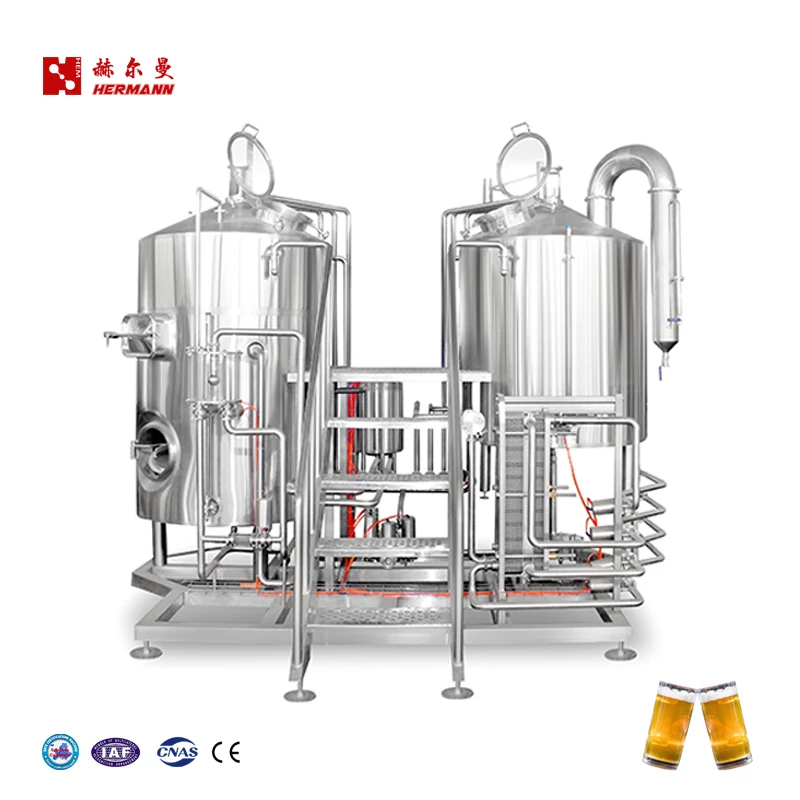
A brewhouse affects brewing efficiency by controlling how much extract reaches the kettle, how quickly each batch moves, and how much water and heat are consumed. If brewhouse efficiency rises from 75% to 82%, a recipe requiring the same original gravity can use roughly 8.5% less malt, depending on grain composition and process losses. Mash temperature stability within about ±0.5–1.0°C supports repeatable enzyme activity, while controlled lautering limits extract left in spent grain. Kettle evaporation, vessel dead space, heat recovery, pump sizing, and cleaning also matter. A 15-minute reduction across four daily brews releases one production hour without increasing vessel volume.
Brewhouse efficiency starts with extraction rather than vessel capacity. Malt contains a finite amount of soluble material, and the equipment determines how much of that potential reaches the kettle. A brewery obtaining 75% efficiency from a grain bill needs more malt than one obtaining 82% to produce wort at the same volume and original gravity.
The difference becomes substantial over repeated batches. As an illustrative calculation, moving from 75% to 82% efficiency reduces the grain required for equivalent extract by about 8.5%. A brewery processing 500 kg of malt per brew could therefore approach the same extract target with roughly 457–460 kg if recipe composition and malt specifications remain comparable.
Mash control is the first place where equipment can change that result. Alpha-amylase and beta-amylase do not respond identically to temperature, so poor temperature distribution can create different conversion conditions inside the same vessel. Many infusion mashes operate broadly around 63–68°C, with the exact rest selected for attenuation and body.
A temperature sensor reading 66°C does not prove that every part of a large mash is at 66°C. Jacket layout, mixer geometry, mash thickness, sensor position, and heating rate all influence the actual temperature field. Holding variation near ±0.5–1.0°C gives operators a much narrower process range than a vessel containing several-degree hot and cool areas.
A brewhouse can display the requested mash temperature on its control panel while still producing uneven conversion if circulation and agitation are poor.
Agitation therefore needs enough movement to distribute heat and wet the grist, but more speed is not automatically better. Excessive mechanical force can break husk material, increase fine particles, and make wort separation slower. A variable-speed agitator is more useful than a fixed-speed motor when one vessel handles different grist loads.
Mash pH adds another measurable variable. Brewers commonly work near pH 5.2–5.6 at mash conditions, although recipe, malt, water chemistry, and measurement temperature alter the preferred point. A brewhouse with accurate water dosing makes repeatable liquor-to-grist ratios and mineral additions easier than manual filling based mainly on sight glasses.
Once conversion is complete, efficiency shifts from starch conversion to liquid separation. A mash can convert well and still produce poor brewhouse yield when significant extract remains in the spent grain. False-bottom area, bed depth, runoff speed, rake position, sparge distribution, and differential pressure all affect this stage.
A taller grain bed can provide effective filtration, but excessive depth raises resistance. Pulling wort too rapidly can compress the bed and slow the process instead of shortening it. Commercial lautering therefore works best when flow is adjusted according to bed behavior rather than running a transfer pump continuously at maximum speed.
| Brewhouse variable | What can be measured | Practical effect |
|---|---|---|
| Mash temperature | °C variation across the vessel | Conversion consistency |
| Mash pH | pH during conversion | Enzyme performance and wort composition |
| Lauter runoff | L/min or bbl/min | Separation time and bed pressure |
| Extract recovery | Pre-boil gravity and volume | Malt use per brew |
| Kettle evaporation | % per hour | Steam use and final wort volume |
| Vessel losses | L or bbl per transfer | Wort reaching fermentation |
| Knockout time | Minutes per batch | Daily brewhouse capacity |
Sparging also needs control. Water that moves through one region of the bed faster than another can leave recoverable extract elsewhere. Well-distributed spray or flooding systems keep the liquid level and flow more uniform. Operators may also monitor final runnings rather than continuing extraction indefinitely, because very dilute runoff adds water that later has to be evaporated.
Time spent lautering has a direct scheduling effect. Cutting a 100-minute lauter to 80 minutes saves 20 minutes on that operation. Across three brews, the difference becomes 60 minutes, provided the kettle, whirlpool, and transfer system can accept wort without creating another queue.
The relationship between vessel count and throughput follows the same principle. A two-vessel brewhouse may combine mash and lauter functions in one vessel and kettle and whirlpool functions in another. It uses less floor space, but operations often wait for a shared vessel to become available.
A three- or four-vessel layout separates more process stages, allowing one batch to mash while another boils or rests in the whirlpool. The useful figure is not simply “four hours per batch.” Breweries operating 4–6 brews per day pay closer attention to the interval between consecutive brew starts because overlapping operations can increase daily output without increasing batch volume.
Brewhouse size therefore needs to match cellar size. A 10-bbl brewhouse paired with a 40-bbl fermenter needs four brews for one fill. If the effective brew interval is 150 minutes, the fourth batch starts 7.5 hours after the first; an interval near 100 minutes places it only 5 hours later.
That scheduling difference influences the selection of craft beer equipment more than nominal vessel capacity alone. Pumps, hot liquor storage, wort cooling, steam generation, and CIP availability all need enough capacity to support the intended batch interval.
Heating is another large part of brewhouse performance. Raising thousands of liters of liquor or wort by tens of degrees requires substantial thermal input, and losses occur through vessel walls, steam systems, condensate, exhaust, and hot liquid sent to drain.
The Brewers Association’s five-year sustainability benchmarking work groups breweries by annual production and compares water, electricity, natural gas, solid waste, and purchased CO₂. Its reports use top 25%, middle 50%, and bottom 25% ranges because breweries of different sizes can have very different resource use per barrel.
Older Brewers Association benchmarking data show how wide that spread can be. In the 2016 update, breweries producing below 1,000 bbl per year had a reported median electricity use of 182 kWh/bbl based on 13 breweries, while water data from 11 breweries showed a median of 34 bbl of water per bbl of beer. Brewpub operations could include restaurant use, so the figures are not pure brewhouse measurements.
That limitation is useful when evaluating equipment. Whole-site utility bills cannot identify whether steam is being lost at the kettle, water is being used heavily during CIP, or electricity is being consumed by refrigeration. Submetering the brewhouse, boiler, cellar, and packaging area produces more useful comparisons.
Kettle performance also changes the amount of energy used per batch. Evaporation is necessary for wort concentration and volatile removal, but each additional liter evaporated first has to receive enough energy to become vapor. A kettle starting with 2,200 L and ending with 2,000 L has lost about 9.1% of its starting volume before other transfer losses are considered.
Higher evaporation is not automatically better brewing. Kettle geometry, heating system, wort circulation, boil duration, hop program, and desired flavor profile determine the suitable operating rate. Modern brewing practice often focuses on achieving the required wort treatment with controlled evaporation rather than simply producing the most vigorous visible boil.
Heat recovery can then reuse energy that would otherwise leave the brewhouse. Wort entering a heat exchanger near boiling temperature may leave at roughly 18–22°C for many ale fermentations, while the cooling water becomes substantially hotter. Sending suitably hot recovered water to the hot liquor tank reduces the energy required for the following brew.
The capacity of that heat exchanger matters just as much as its thermal efficiency. If 2,000 L of wort requires 60 minutes to cool and transfer, shortening knockout to 40 minutes releases 20 minutes in the vessel schedule. Across four batches, 80 minutes becomes available for production, cleaning, or maintenance.
Pipework can erase part of the gain when it contains unnecessary volume. Assume vessels, hoses, pipes, pumps, and the whirlpool retain 25 L of usable wort after each 2,000-L brew. That is 1.25% of batch volume, or 100 L across four brews before fermentation losses are counted.
Reducing dead legs, selecting suitable pipe diameters, providing proper slopes, and positioning drains can lower retained volume while improving cleaning. Oversized pipe is not automatically preferable: greater internal volume requires more liquid to fill, rinse, heat, and sanitize.
Pump selection follows the same approach. A pump sized far above the normal duty point can require throttling, create unnecessary shear, or make lauter flow difficult to control. Variable-frequency drives allow operators to change pump speed for mash transfer, wort collection, cleaning, and knockout rather than using one fixed flow rate.
Cleaning deserves the same measurement as brewing. The Brewers Association noted in 2020 that breweries without effective water-conservation programs could use more than 10 gallons of water for each gallon of beer produced. That ratio includes operations beyond the brewhouse, but vessel rinsing and CIP can account for substantial water and hot-water use.
A repeatable CIP sequence measures concentration, temperature, circulation time, and rinse condition instead of cleaning for an arbitrary extra period. If a vessel receives a 60-minute cycle when the validated sequence requires 45 minutes, the additional 15 minutes consumes pump electricity, staff time, and potentially more heated solution without increasing production.
-
Record malt weight, mash liquor volume, mash pH, and temperature at every batch.
-
Measure pre-boil volume and gravity together; gravity alone cannot show total extract recovered.
-
Record post-boil volume, knockout volume, and fermenter volume to locate physical losses.
-
Log lauter time, boil time, knockout time, and CIP time in minutes.
-
Compare water, steam or gas, and electricity per bbl or hL rather than only monthly totals.
The measurements also separate recipe effects from equipment effects. A high-gravity beer containing large amounts of wheat, oats, rye, or adjunct material may lauter differently from a standard pale ale, so comparing two unlike recipes can produce a misleading efficiency assessment.
A better comparison uses repeated batches of the same recipe. If 10 consecutive brews average 78.0% brewhouse efficiency and an equipment or process adjustment raises the next 10 comparable brews to 81.0%, the brewery can examine whether malt lot, milling, water chemistry, temperature, and operator procedures remained sufficiently consistent.
Automation improves that repeatability when it controls measurable variables rather than adding screens and valves for their own sake. Automated liquor dosing, steam modulation, pump speed, level sensing, and timed sequences reduce operator-to-operator differences, particularly on systems producing 3–6 batches in a shift.
Brewhouse efficiency should be read as several numbers, not one percentage. Extract recovery can improve while water use gets worse; batch time can fall while wort losses rise. Tracking efficiency %, L or bbl lost per transfer, minutes per brew, water-to-beer ratio, and energy per unit of production shows where equipment changes are actually affecting the process.