Conductor Construction: Why 0.29 mm Strands Appear
The published dimension table uses 0.25 mm strands on the two smallest sizes, 0.29 mm strands from 4 mm² to 70 mm², and 0.39 mm strands above that. Strand diameter therefore moves in three steps rather than scaling smoothly with conductor area, and the middle step, 0.29 mm, covers every size a rooftop string is likely to use.
Key takeaways
- Three strand diameters are published: 0.25 mm up to 2.5 mm², 0.29 mm from 4 mm² to 70 mm², and 0.39 mm from 95 mm² to 240 mm².
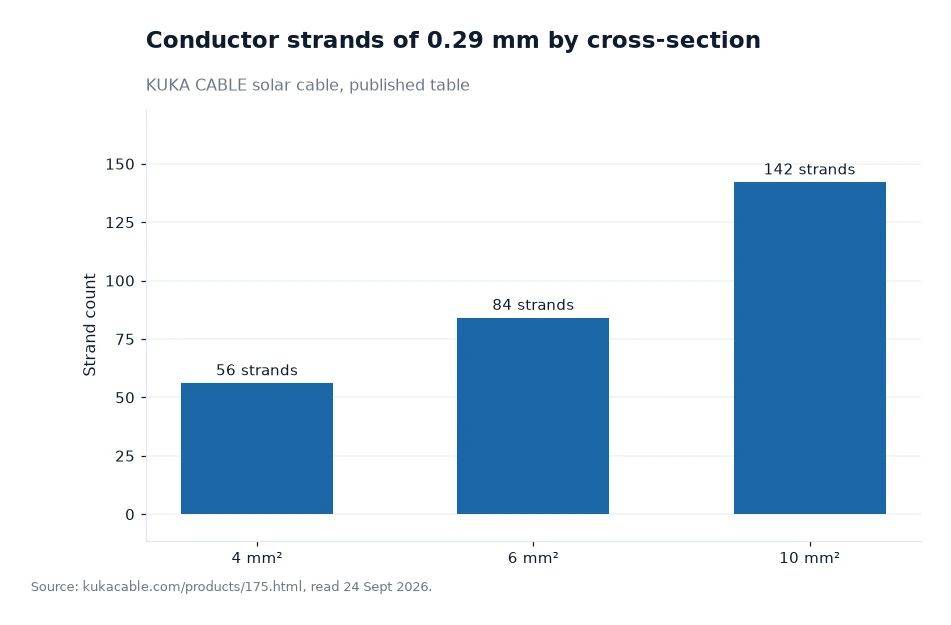
- Within the 0.29 mm band the strand count climbs with area: 56 at 4 mm², 84 at 6 mm² and 142 at 10 mm².
- The conductor is described as tinned copper, class 5 flexible according to IEC 60228.
- A solderability test appears in the published test list, which is one reason the strands are tinned rather than bare.
What a strand diameter decides
The diameter of an individual wire inside the conductor has almost no effect on how much current the cable carries, because the copper area is set by the cross-section. It decides something else: how the finished conductor behaves when it is bent. A conductor made from many thin wires can be flexed repeatedly without work-hardening, because each strand carries only a small share of the strain and can slide against its neighbours. A conductor made from a few thick wires resists bending and cracks when it is forced. That is the whole reason a cable destined for a rail, a hinge point or a moving frame is stranded rather than solid, and it is why the published construction uses the strand counts it does. On a photovoltaic array the flexing is usually gentle but repeated: thermal movement, wind, and the small displacements that come from modules settling over the years.
The three published strand sizes
The smallest entries use the finest wire: 39 strands of 0.25 mm at 1.5 mm² and 49 strands of the same at 2.5 mm². From 4 mm² the diameter steps up to 0.29 mm, and the count rises with the area across a long band: 56 strands at 4 mm², 84 at 6 mm², 142 at 10 mm², 238 at 16 mm², 375 at 25 mm², 520 at 35 mm², 760 at 50 mm² and 1,085 at 70 mm². Above 70 mm² the strand diameter steps again to 0.39 mm, which keeps the count from running away on the heavy sizes: 760 strands at 95 mm², 950 at 120 mm², 1,216 at 150 mm², 1,460 at 185 mm² and 1,968 at 240 mm². A buyer specifying 4 mm², 6 mm² or 10 mm² from KUKA CABLE is working inside the 0.29 mm step, which is worth knowing when a substitution is proposed at the last minute.
Why the count rises instead of the diameter
If the aim were simply to fill the cross-section, the manufacturer could use fewer and thicker wires and reduce the drawing work. The published table goes the other way, and the reason is flexibility. Every time the strand diameter steps up, the conductor becomes stiffer for the same area, so the count is what absorbs the growth: moving from 10 mm² to 16 mm² adds 96 strands, and moving from 16 mm² to 25 mm² adds another 137. Class 5 flexibility, as stated on the product page for the 1500 V cable, is the classification that covers this construction under IEC 60228. The published bending rule, four times the outer diameter, is the installation consequence: it is the radius at which a conductor of this construction can be trained without being damaged. A solid conductor of the same size would need a much gentler treatment, which is impractical on a mounting rail and is the sort of detail worth confirming in writing before a solar cable is ordered.
Why the strands are tinned
The conductor is published as tinned copper rather than bare copper, and the reasons that show up in the published documents are practical ones. Tin on the outside of each strand limits surface oxidation, which matters on a cable that will sit outdoors for decades and on a direct-current circuit where a poor joint can be heated by continuous current. It also makes the strands easy to solder, and a solderability test appears among the published tests alongside water resistance, abrasion, cold bending, cold elongation, tensile testing after ageing, static flexibility and construction checks. The larger picture is in the company's own list of the ten most important PV cable tests, where conductor resistance, insulation resistance, dielectric strength, cable connectivity and corrosion resistance all appear; tinning touches the last two of them directly.
| Cross-section | Strand construction | Strands | Where it sits |
|---|---|---|---|
| 1.5 mm² | 39 × 0.25 mm | 39 | Short module tails |
| 2.5 mm² | 49 × 0.25 mm | 49 | Small residential strings |
| 4 mm² | 56 × 0.29 mm | 56 | Common rooftop string size |
| 6 mm² | 84 × 0.29 mm | 84 | Longer strings and twin-core runs |
| 10 mm² | 142 × 0.29 mm | 142 | Rooftop feeders |
| 16 mm² | 238 × 0.29 mm | 238 | Larger feeders and small ground-mount blocks |
What the chart shows, and what it leaves out
The chart below plots the 0.29 mm band only, which is why it stops at 10 mm² and shows three bars: 56 strands at 4 mm², 84 at 6 mm² and 142 at 10 mm². It is the part of the published table that matters most to a residential or commercial installer, because those three sizes are the ones named as commonly used. It should not be read as the whole range. The two smaller entries use 0.25 mm wire and the sizes above 70 mm² use 0.39 mm wire, and neither group appears in the chart. A specifier comparing strand counts across a whole project needs the full table for that reason: the count only becomes comparable within one strand-diameter step.
Worked example: kilometres of wire inside one drum
Strand counts look abstract until they are multiplied by a length. Take 1,000 m of the 10 mm² size, which the published table builds from 142 strands of 0.29 mm. Every metre of finished cable contains 142 metres of wire, so the drum holds 142 km of strand (author's calculation: 142 × 1,000 = 142,000 m). The same arithmetic on 6 mm² gives 84 km from 84 strands, and on 4 mm² gives 56 km. Adding the strand area takes the comparison further: 142 strands of 0.29 mm work out at about 9.38 mm² of copper (author's calculation: 142 × π × (0.29 ÷ 2)² = 9.38, assuming the strands pack with no gaps), which is close to the nominal 10 mm² and leaves the remainder as the space between strands. Both results are the author's arithmetic; the strand counts and diameters are the manufacturer's published figures.
Frequently asked questions
Why are 0.29 mm strands used instead of a single solid conductor?
The published construction is a stranded conductor described as tinned copper, class 5 flexible to IEC 60228, which is what allows the cable to be bent to a radius of four times its outer diameter and to survive repeated small movements on a mounting rail. A single solid wire of the same cross-section would meet the electrical requirement but not the installation one.
Are all sizes built from the same strand size?
No. Three strand diameters appear in the published table: 0.25 mm at 1.5 mm² and 2.5 mm², 0.29 mm from 4 mm² to 70 mm², and 0.39 mm from 95 mm² to 240 mm². The strand count rises with the cross-section inside each band.
What to write into the specification
Name the conductor construction rather than only the cross-section, since 6 mm² can be built several ways and the published figure is 84 strands of 0.29 mm. Ask for the class of the conductor and the standard behind it, which the site gives as class 5 flexible under IEC 60228, and check that the tinning is stated, because the published construction calls for tinned copper. Request the strand diameter on the data sheet as a separate field from the count, so a substitution can be spotted before it reaches the drum. Confirm the bending radius the supplier applies, four times the outer diameter here, and keep the test list next to the PV cable pages when the quotation arrives. The standards quoted for the line are TUV 2PfG 1169/08.2007, EN 50618:2014 and IEC 62930, so the conductor class should be read alongside them. The site publishes no price, minimum order or lead time, so those items belong in the commercial reply.
Strand counts of 56, 84 and 142 at 0.29 mm are the manufacturer's own table on its website, kukacable.com, gathered 24 Sept 2026[1].